
Switzerland · 18.05.2026
Glarus Süd-Grosstal

Moderate
Danger level
Moderate — Heightened avalanche conditions on specific terrain features
Triggering is possible, primarily from high additional loads, particularly on indicated steep slopes.
Evaluate snow and terrain carefully. Identify features of concern.
Avalanche problems
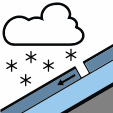
New snow
Instability related to current or recent snowfall. Additional loading onto the existing snowpack is the crucial factor.
Wait until the snowpack has stabilised, or avoid steep terrain affected by recent snow.
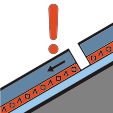
Persistent weak layers
One or more persistent weak layers in the old snowpack, such as faceted crystals or depth hoar.
Travel conservatively. Remote triggering and crack propagation over long distances is possible.
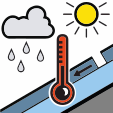
Wet snow
Weakening of the snowpack due to liquid water from melt or rain infiltrating the snowpack.
Good timing and trip planning are important. Consider avalanche runout zones.
Stability
SnowpackThe new snow and wind-drifted snow from recent days are still partly prone to triggering, especially on shaded slopes in high alpine terrain. At the transition to the underlying old snowpack, coarse-grained weak layers are still present in some places, particularly on north- and east-facing slopes at higher elevations.
Snow quality
SnowpackThe new snow and wind-drifted snow from recent days are still partly prone to triggering, especially on shaded slopes in high alpine terrain. At the transition to the underlying old snowpack, coarse-grained weak layers are still present in some places, particularly on north- and east-facing slopes at higher elevations.
Tendency
Outlook to WednesdayMonday night into Tuesday will be partly cloudy in the east and a little snow will fall above 1800 m. In the morning, there will still be residual clouds in the east. Elsewhere, it will be quite sunny at first before clouds move in from the west. In the afternoon, there will be showers in the west, falling as snow above 2200 m. Tuesday night into Wednesday will be clear in the south and often cloudy elsewhere. In central and eastern Switzerland, up to 10 cm of snow will fall above approximately 2200 m. During the day, it will be cloudy with showers in the east. In the west, conditions will be changeable, and in the south it will be quite sunny. There will be a westerly wind on both days, mostly light on Tuesday and moderate at times on Wednesday. The zero-degree level will be at 2500 m on Tuesday, rising towards 2800 m on Wednesday afternoon.The danger of dry avalanches will decrease. Dry avalanches can still be triggered, primarily on very steep north- and east-facing slopes in the high alpine regions. The danger of wet avalanches will increase slightly as each day progresses. Backcountry ski tours should be completed early.