
AVY Base
Avalanche bulletins
France, Norway, Switzerland, Austria, Sweden, New Zealand
Select a country, then a region. All forecasts use the same EAWS layout, danger icons and problem types. How our data works
Some forecast text on this page is machine-translated. How our data works
Updated 12.10.2026 07:08
European Avalanche Danger Scale
Official scale used by European avalanche warning services.

5 — Very high
Snowpack stability
The snowpack is poorly bonded and largely unstable in general.
Likelihood of triggering
Numerous very large and often extremely large natural avalanches can be expected, even in moderately steep terrain.
4 — High
Snowpack stability
The snowpack is poorly bonded on most steep slopes.
Likelihood of triggering
Triggering is likely, even from low additional loads, on many steep slopes. In some cases, numerous large and often very large natural avalanches can be expected.

3 — Considerable
Snowpack stability
The snowpack is moderately to poorly bonded on many steep slopes.
Likelihood of triggering
Triggering is possible, even from low additional loads, particularly on the indicated steep slopes. In certain situations some large, and in isolated cases very large natural avalanches are possible.

2 — Moderate
Snowpack stability
The snowpack is only moderately well bonded on some steep slopes; otherwise well bonded in general.
Likelihood of triggering
Triggering is possible, primarily from high additional loads, particularly on the indicated steep slopes. Very large natural avalanches are unlikely.

1 — Low
Snowpack stability
The snowpack is well bonded and stable in general.
Likelihood of triggering
Triggering is generally possible only from high additional loads in isolated areas of very steep, extreme terrain. Only small and medium natural avalanches are possible.
Avalanche problems
Typical problem types defined by EAWS.
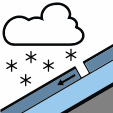
New snow
The avalanche problem is related to current or most recent snowfall. The amount of additional loading by new snow onto the existing snowpack is the crucial factor of the new snow problem. How critical the loading is, depends on various factors such as air temperature, wind or characteristics of the old snow surface.
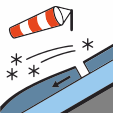
Wind slab
Wind slabs are formed when loose snow in near-surface layers (new snow or old snow) is transported and deposited by wind.
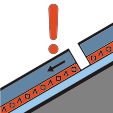
Persistent weak layers
The avalanche problem is related to the presence of one or more persistent weak layers in the old snowpack. These weak layers typically include faceted crystals, depth hoar or surface hoar crystals.
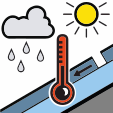
Wet snow
The avalanche problem is related to a weakening of the snowpack due to the presence of liquid water. Water infiltrates the snowpack due to melt or rain.
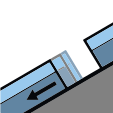
Gliding snow
The entire snowpack is gliding on the ground, typically on smooth ground such as grassy slopes or smooth rock zones. High activity of glide-snow avalanches is typically related to a thick snowpack with no or only few weak layers. Glide-snow avalanches can occur both with a cold dry snowpack and with a warm moist or wet snowpack. The release of a glide-snow avalanche is difficult to predict, although in many cases glide cracks open prior to release.
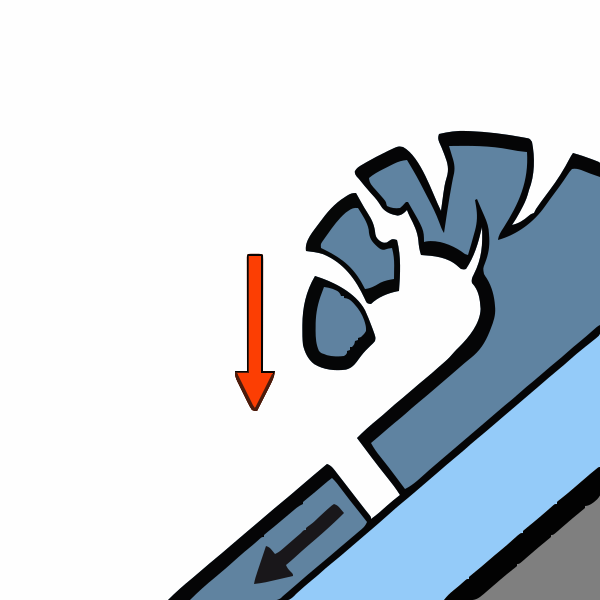
Cornices
A wave-like formation of soft or hard wind drifted snow, often overhanging.